
Liquid Pressure Amplification for Reliable, Efficient Refrigeration
Liquid Pressure Amplification (LPA®) stabilises liquid refrigerant under low‑pressure conditions, improving system reliability, efficiency, and operating envelope performance. DX Free Cooling
LPA® is a proven method for improving liquid stability in refrigeration systems. It integrates easily into existing designs, delivering higher reliability, lower energy use, and consistent performance across all refrigerant types.
Why LPA® Matters
Stable Liquid Supply
Modern low‑GWP refrigerants operate at lower pressures and narrower liquid margins. LPA® ensures a stable liquid column to the expansion device. Liquid stability refers to maintaining refrigerant in a fully liquid state from the condenser or receiver to the expansion device.
Improved Expansion Valve Performance
Consistent liquid quality improves TXV/EEV stability, especially under floating‑head or low‑ambient conditions
Higher System Efficiency
Reducing compressor workload and supporting lower condensing pressures improves overall system efficiency.
Together, these benefits ensure predictable system behaviour across all refrigerants, including modern low‑GWP blends.
Why Liquid Stability Matters
Even modest pressure drops can cause premature flashing, reducing system performance and destabilising expansion‑valve control. LPA® prevents this by increasing liquid pressure just enough to keep refrigerant fully liquid — even in:
- Long or complex liquid lines
- Vertical lifts
- Low‑ambient conditions
- High‑efficiency, low‑head‑pressure operation
- Systems using low‑GWP refrigerants
Stable liquid means stable performance
How Liquid Pressure Amplification Works
The LPA® pump is installed in the liquid line after the condenser or receiver. It provides a small pressure increase that adds only the pressure required to eliminate flashing — typically 0.5 to 5 bar depending on system design;
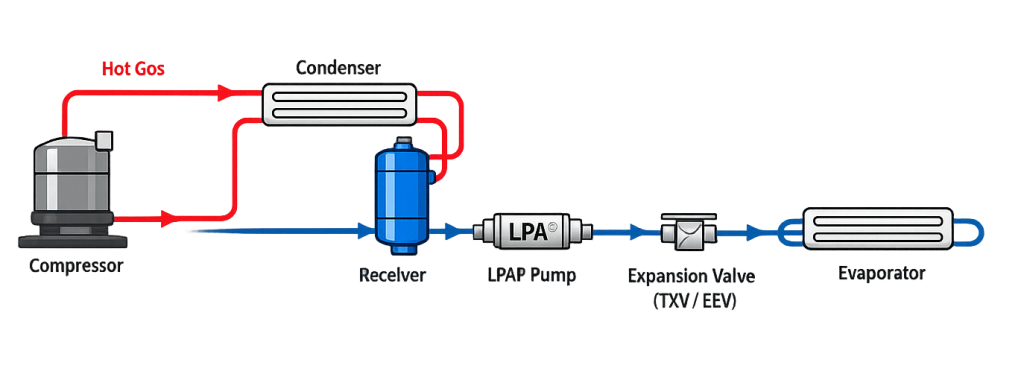
- Raises the refrigerant’s saturation temperature
- Prevents flashing in the liquid line
- Ensures consistent liquid quality to the TXV/EEV
- Improves evaporator performance
- Supports lower condensing pressures for higher efficiency
Applications
- Supermarkets & retail refrigeration
- Cold storage & distribution
- Data centres and IT facilities
- Industrial process cooling
- Heat pumps & heat recovery
- CO₂ transcritical & subcritical systems
- Low‑head & floating‑head pressure environments
- LPA® integrates easily into both new system designs and retrofit applications
Why HY-SAVE®
For over 40 years, HY‑SAVE has engineered liquid stability solutions for refrigeration and heat‑transfer systems worldwide. Our technology is used by leading OEMs and engineering firms worldwide.
- UK & EU manufacturing
- Proven reliability in global deployments
- Independent, OEM‑neutral technology
- Engineering‑led product development
- Long‑term technical support
Definitions
- Liquid pressure amplification — improves liquid stability under low‑pressure conditions.
- Refrigerant flashing — common issue solved by maintaining positive liquid pressure
- Liquid line booster — increases pressure to prevent vapour formation in long pipe runs
- Liquid line flashing — caused by pressure drop or insufficient subcooling
- TXV instability — often linked to poor liquid feed
- Refrigerant pressure booster — used to stabilise liquid supply in long pipe runs