
DX Free Cooling
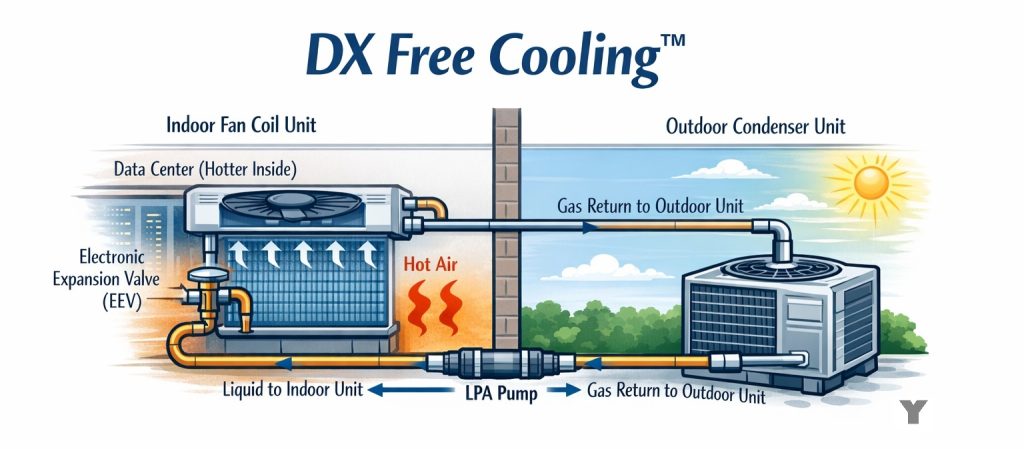
DX Free Cooling with Liquid Pressure Amplification (LPA®)
DX free cooling, also referred to as DX economized cooling, is an energy‑efficient refrigeration strategy that allows heat rejection to ambient conditions without relying on mechanical compression. By exploiting low outdoor temperatures, DX free cooling systems can significantly reduce energy consumption, operating costs, and compressor run hours in mission‑critical cooling applications.
Liquid Pressure Amplification (LPA®) enables DX free cooling by maintaining stable refrigerant flow and pressure differential during low‑ambient operation—conditions where conventional DX systems typically struggle.
How DX Free Cooling Works
In a DX free cooling system, heat is rejected directly to ambient air when outdoor temperatures are sufficiently lower than indoor return conditions. Instead of relying on compressor operation, refrigerant circulation is maintained to transfer heat efficiently through the condenser.
LPA® technology plays a critical role by overcoming the reduced pressure differential that naturally occurs at low ambient temperatures. This allows DX systems to operate in economized cooling mode while maintaining control, stability, and performance.
Cooling Capacity and Temperature Differential (ΔT)
When properly engineered, 100% cooling capacity can be achieved in DX free‑cooling mode when a minimum temperature difference of approximately 6 K exists between indoor return air temperature and outdoor ambient temperature.
This relatively small ΔT enables full economized operation because the LPA® pump maintains sufficient refrigerant circulation and liquid pressure, even during low‑ambient conditions. As a result:
Seasonal energy efficiency is significantly improved
Compressor operation can be fully eliminated during free cooling
System capacity is maintained without mechanical refrigeration
Applications for DX Economized Cooling
DX free cooling systems are well suited to applications where continuous heat rejection and high reliability are essential, including:
- Data centre cooling and server rooms
- Remote electrical switch‑gear enclosures
- Rail infrastructure, subways, and underground systems
- Industrial process cooling
- Critical commercial HVAC systems
Cooling capacities typically range from 15 to 150 tons per circuit, making DX economized cooling scalable across a wide range of industrial and commercial environments.
Role of Liquid Pressure Amplification (LPA®)
Liquid Pressure Amplification (LPA®) is an enabling technology that allows DX systems to function reliably in free‑cooling mode when ambient temperatures are low.
In conventional DX systems, reduced condenser pressure can lead to:
- Inadequate refrigerant flow
- Flow instability and control issues
- Forced compressor operation, even in cool conditions
LPA® addresses these limitations by:
- Actively maintaining refrigerant circulation
- Stabilizing system pressure during low‑ambient operation
- Enabling full‑capacity DX free cooling at reduced ΔT
This makes LPA® a key component for developers pursuing high‑efficiency DX economizer designs.
System Architecture and Responsibility
HY‑SAVE® does not design, supply, or sell complete DX refrigeration circuits.
HY‑SAVE® provides LPA® pump technology as a building block that developers, OEMs, and consulting engineers may integrate into their own DX free‑cooling system architectures.
System developers are responsible for:
- Refrigeration circuit design
- Refrigerant selection and control strategy
- Operating envelope analysis
- Integration of LPA® within the DX system
Engineering and Upgrade Considerations
Implementing or retrofitting DX free cooling requires a thorough understanding of:
- Refrigeration thermodynamics
- Low‑ambient operating behavior
- Mode‑change control strategies
A qualified refrigeration engineer ensures that DX economized cooling—enabled by LPA®—is implemented safely, efficiently, and in line with performance expectations. Proper engineering maximizes energy savings while maintaining long‑term system reliability.